WHO IS SWOON?
Caledonia Curry, also known as Swoon
Caledonia Curry, the artist and filmmaker known around the world as Swoon, was born Caledonia Dance Curry in 1977 in New London, Connecticut, and raised in Daytona Beach, Florida. She grew up in a household shaped by addiction and instability.
Both of her parents struggled with opioid addiction, and that early experience of human fragility, and of the resilience that can answer it, would go on to sit at the very centre of Caledonia Curry’s life’s work.
Art arrived early, and it arrived as a lifeline. At the age of ten, she was enrolled in painting classes among a group of retired artists who, in her own words, “adopted” her and taught her to paint. She has credited that beginning with making her “a focused, confident artist,” and with steering her away from the path that ran through her family. At nineteen she moved to Brooklyn, New York, to study painting at the Pratt Institute, graduating in 2001.
It was there, while still a student, that she found the medium and the method that would make her name.

From the Streets of Brooklyn
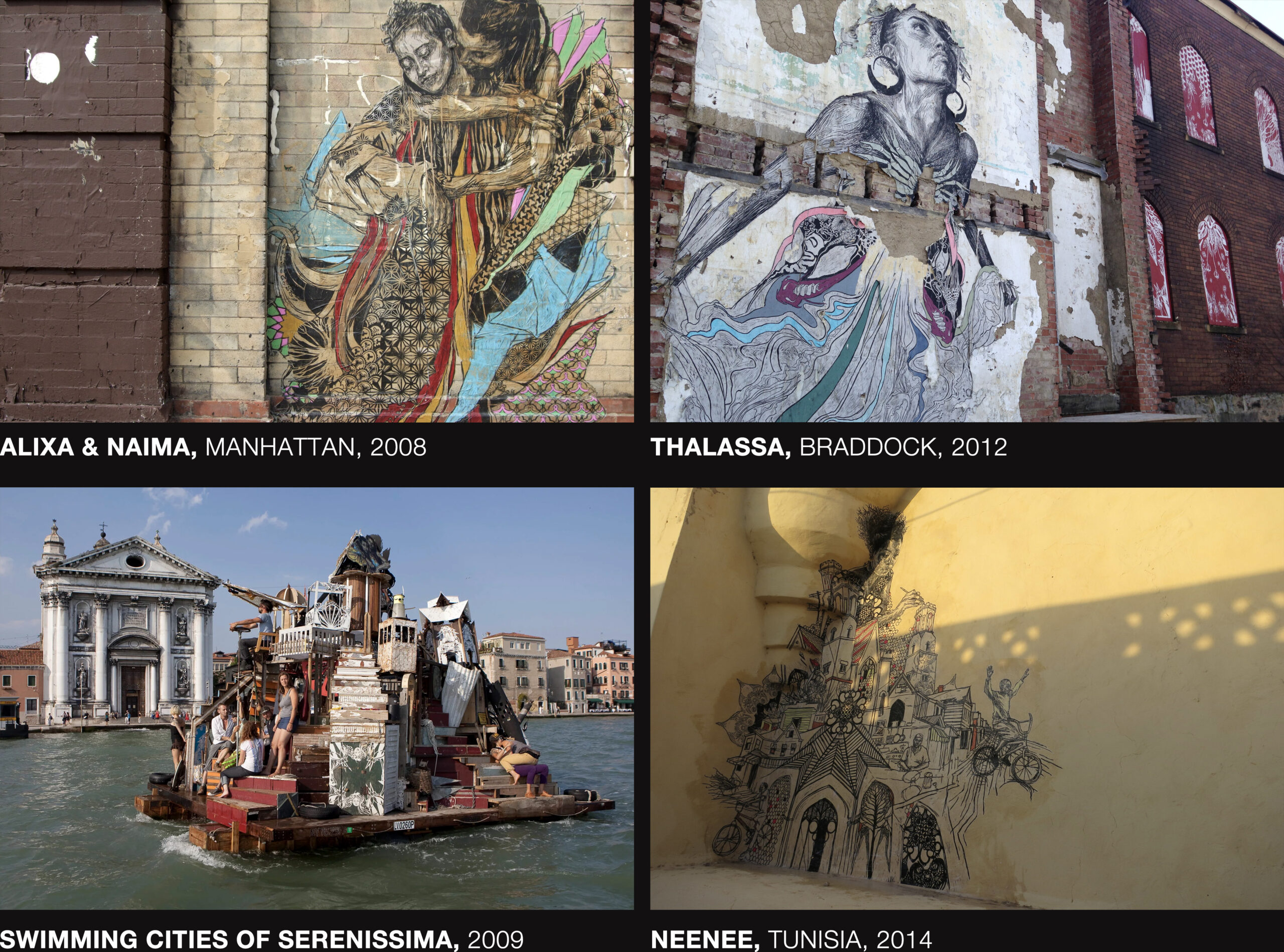
Frustrated by what she saw as the narrow horizons of the traditional gallery world, Caledonia Curry took her work to the street. Using nothing more elaborate than a sheet of paper and a knife, the materials she could afford, she began cutting and printing intricate, life-sized portraits and wheatpasting them onto the facades of decaying buildings across Brooklyn. The faces were ordinary people, friends, family, strangers, rendered with extraordinary tenderness and at a scale that demanded to be seen.
Working at first anonymously, she became one of the most distinctive voices to emerge from the street art movement of the early 2000s, and is widely recognised as one of the first women to gain international recognition in street art. In a field that had been overwhelmingly male, she expanded what the form could mean, not only aesthetically but ethically, opening the door for a generation of women artists who followed.
Her portraits were never about vandalism or branding. They were acts of witness: a way of placing the overlooked and the unseen back into the public eye, at full human scale, in the heart of the city. From the beginning, her critical engagement with social and environmental justice has placed her at the forefront of the discourse around socially-engaged art.

The Swimming Cities
If the wheatpaste portraits announced her vision, it was a series of audacious, collaborative adventures that revealed its scale. Across the mid-2000s, Caledonia Curry led the construction of fleets of floating sculptures built from salvaged and recycled materials, crewed by friends and fellow artists, and sailed them down some of the world’s great waterways.
The Miss Rockaway Armada travelled the Mississippi River in 2006 and 2007. Swimming Cities of Switchback Sea took to the Hudson in 2008. And in 2009, the Swimming Cities of Serenissima crossed the Adriatic and arrived, uninvited, at the Venice Biennale, one of the most prestigious events in the global art calendar. Along the way, the crews stopped in small towns to perform music and theatre for whoever gathered to watch.
These projects captured everything that makes Swoon’s practice singular: ambition without permission, art as a shared and lived experience, and a deep belief in what people can build together.

Art as a Force for Healing
For Caledonia Curry, art has never been separate from life, or from the communities that art can serve. Across post-disaster zones, communities affected by addiction, and towns hollowed out by economic crisis, she has built long-term projects that treat art not as a record of suffering but as an instrument of recovery.
In 2015 she founded the Heliotrope Foundation to carry this work forward. Its projects include Konbit Shelter, a sustainable building initiative developed in the aftermath of the 2010 Haiti earthquake; Music Box Village in New Orleans, an immersive musical environment created in response to Hurricane Katrina; and Braddock Tiles, a job-readiness programme for young people in a Pennsylvania town shaped by decades of economic decline.
Drawing on her own family’s experience of addiction, she also developed The Road Home in North Philadelphia, working alongside Mural Arts Philadelphia to serve a community living through the opioid epidemic, through art therapy workshops, harm-reduction sessions and a public symposium. In 2020, Heliotrope launched a collaboration with Za’kiyah House, repurposing a building in Braddock to provide trauma-informed transitional housing for people leaving prison or facing other extreme crisis.
Her gallery and museum work and her work in communities have never been separate worlds. The activism shapes the exhibitions, and the exhibitions carry the activism: one practice, approached throughout with the same rigour and the same care.

Into the World’s Great Institutions
The institutions took notice early, and unequivocally. Beginning entirely on her own terms, Swoon’s work has arrived in the permanent collections of the Museum of Modern Art, Tate Modern, the Detroit Institute of Arts and the Massachusetts Museum of Contemporary Art (MASS MoCA), among many others, alongside a permanent site-specific installation at MoMA PS1.
Her exhibitions have spanned the globe, from the Institute of Contemporary Art, Boston to the Mori Art Museum in Tokyo. In a landmark moment, the Brooklyn Museum dedicated to her the first solo exhibition it had ever given to a living street artist. Her first museum retrospective, ‘The Canyon: 1999 to 2017’, was presented at the Contemporary Arts Center, Cincinnati.
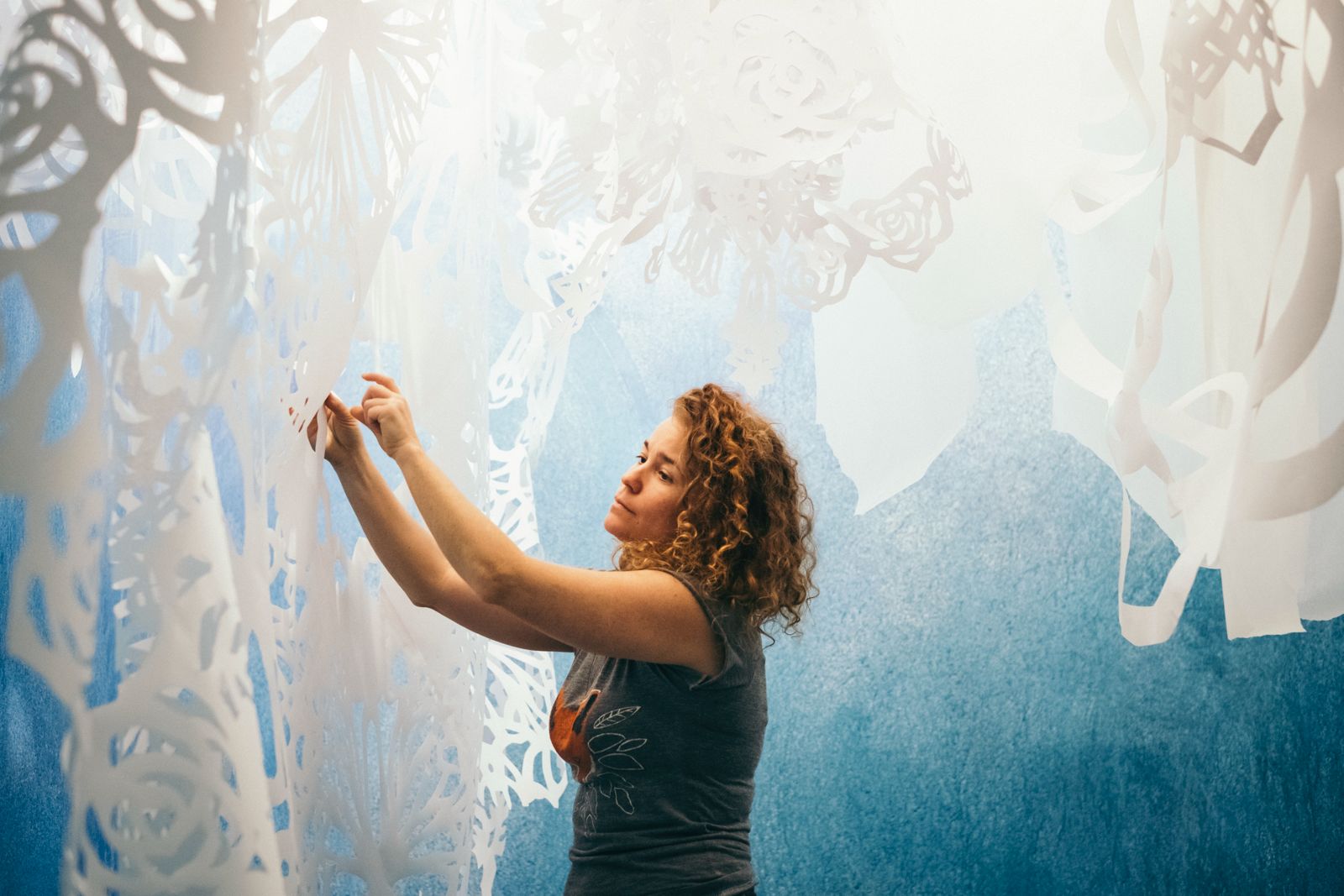
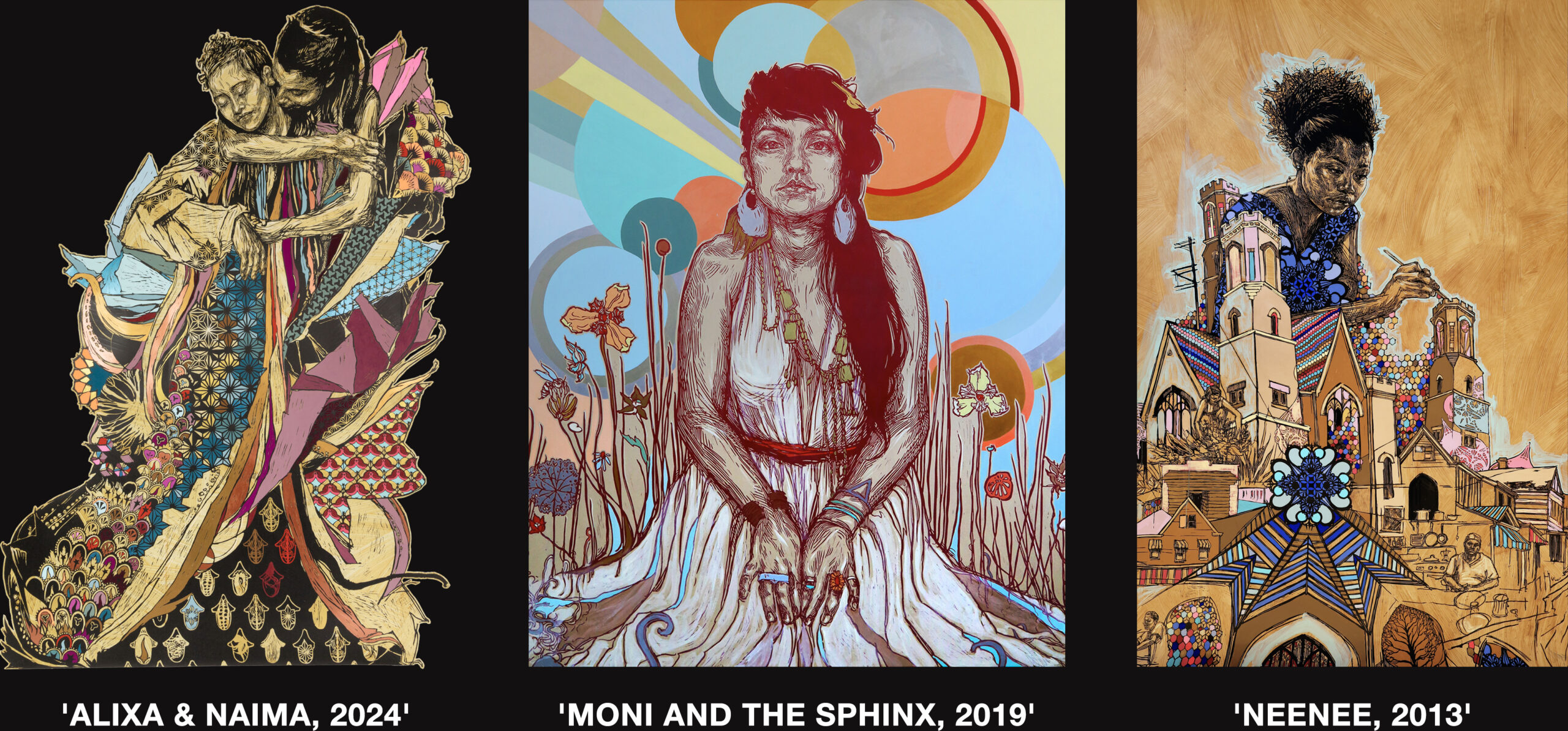
Through all of it, the work itself has only grown: more technically inventive, more emotionally precise, more ambitious in reach. A classically trained printmaker, Caledonia Curry has continually innovated new approaches to large-scale relief printing and intricate papercut work, while expanding into painting, sculpture, installation and stop-motion animation.

The ‘Sibylant Sisters’
Most recently, that expansion has carried her into long-form narrative world-building. Her ongoing project, ‘Sibylant Sisters’, is a complete fiction with its own cast of characters, plot, setting and history, rooted in her own experience of growing up in a family shaped by addiction and psychological instability.
It unfolds across exhibitions and performances, books, film and, most recently, an interactive Oracle Deck. Through this and other long-form stories now in development, Caledonia Curry is reaching for the transformative power of ancient narrative forms, the fairytale and the fable, experienced in entirely modern ways. It marks one of the most significant creative transitions of her career, and a body of work in full momentum.
This is also the direction of her work as a filmmaker. In 2021 she premiered ‘The House Our Families Built’, a major public art commission in collaboration with PBS American Portrait, and she is currently developing a full-length narrative film that brings together drawing, immersive installation, stop-motion animation and her collaborative practice with the traditions of storytelling on screen.

Swoon’s Legacy & Influence
Few artists have moved so completely between worlds: from the unsanctioned walls of Brooklyn to the permanent collections of the world’s leading museums, and from the solitary act of cutting paper to vast collaborative projects that have reshaped communities.
Her influence runs in two directions at once. She helped redefine what street art could be, both for the women who came after her and for the institutions that had to widen to receive her. And she has stood at the forefront of socially-engaged art, insisting through every chapter of her practice on a single founding conviction: that art belongs to everyone, that it can heal as well as inspire, and that the people most often rendered invisible deserve to be seen at the fullest possible scale.

Woodbury House & Swoon
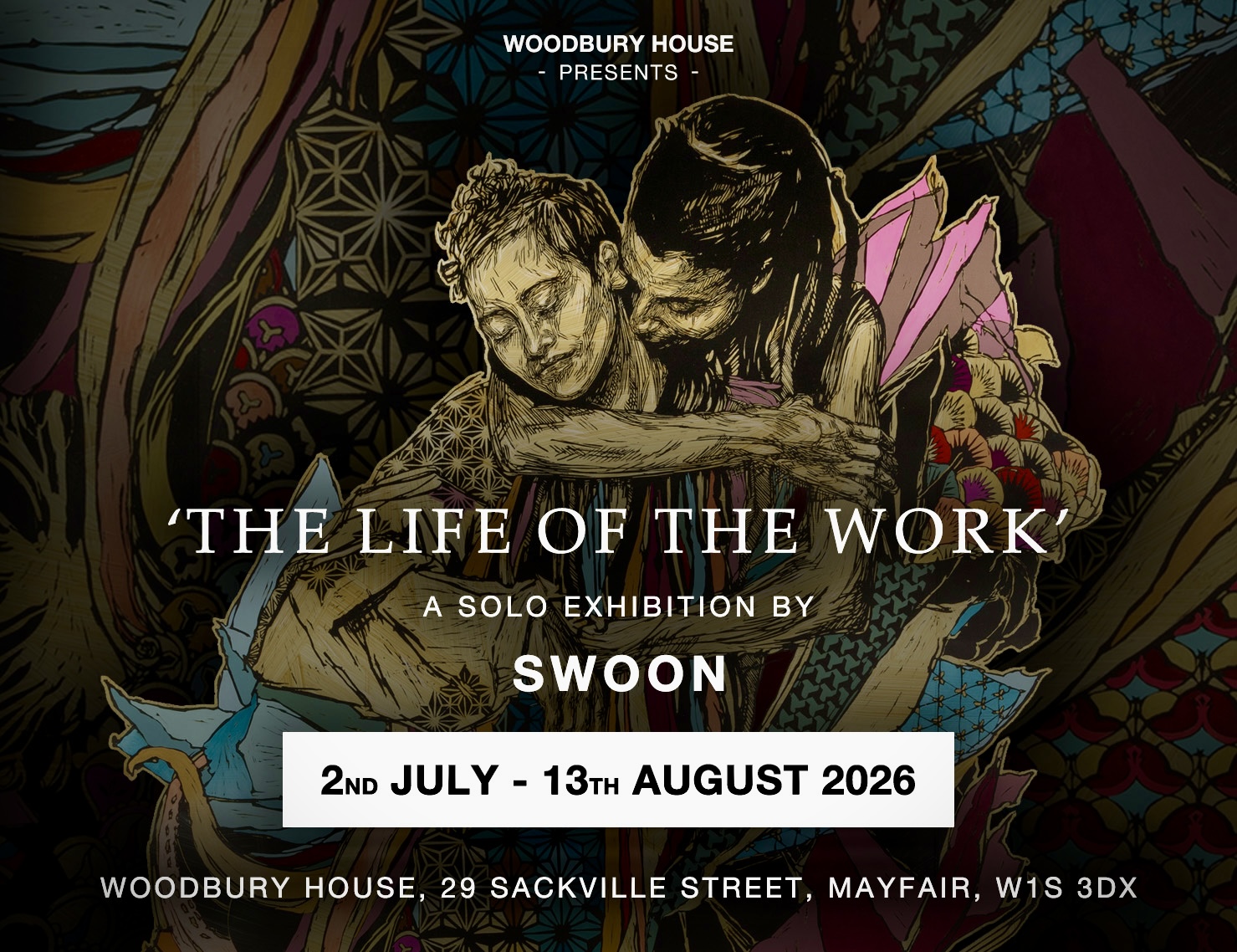
This summer, Woodbury House is proud to present ‘The Life of the Work’, a solo exhibition by Swoon at our flagship Mayfair gallery, and the first major survey of her practice to be presented in the United Kingdom.
On view are more than a decade of works ranging across every register of her output, from the monumental to the miniature: hand-sewn mylar portraits reaching nine feet in height, intricate block prints and silkscreens, works mounted onto salvaged doors and reclaimed windows, drawings of extraordinary tenderness, and the most recent pieces drawn from her ‘Sibylant Sisters’ universe.
‘The Life of the Work’ runs from 2nd July to 13th August 2026 at Woodbury House, 29 Sackville Street, Mayfair.
For those who wish to live with the work of Caledonia Curry, Woodbury House is glad to help. We can offer guidance on available works, provenance and the wider context of her practice, drawing on our experience and our relationships across the art world. Whether you are beginning to explore her work or considering an acquisition, we are always happy to talk.
Want to Learn More About Swoon?
Are you interested in upcoming exhibitions, available works, exclusive insights or unique opportunities? Let’s connect and explore the world of Swoon together.
Contact Us
- – Email: [email protected]
- – Phone: +44 203 750 2222
- – WhatsApp: +44 7548 343342
Woodbury House, 29 Sackville Street, Mayfair, London W1S 3DX
CONTACT US
‘The Life of the Work’, a solo exhibition by Swoon
This summer, Woodbury House presents the first major survey of Swoon’s practice ever staged in the United Kingdom, and the artist’s first exhibition with the gallery.
We are delighted to announce, ‘The Life of the Work’, a solo exhibition by Swoon (Caledonia Curry), opening at our flagship Mayfair gallery this July. It is the artist’s first exhibition with Woodbury House, and a landmark moment for the gallery: the first major survey of her work in the United Kingdom.
The exhibition runs from 2nd July to 13th August 2026 at Woodbury House, 29 Sackville Street, Mayfair. On view will be thirty-six works spanning more than a decade of making, from monumental portraits reaching nine feet in height to intricate prints, cut-paper assemblages, and the most recent pieces from her ongoing ‘Sibylant Sisters’ universe.
An artist whose work makes things happen
There are artists who make work, and there are artists whose work makes things happen: in communities, in institutions, in the way people understand what art is for. Swoon belongs firmly to the second kind. Over more than two decades she has built one of the most distinctive and humane practices in contemporary art, beginning on the walls of Brooklyn without permission and arriving, entirely on her own terms, in the permanent collections of the Museum of Modern Art, the Brooklyn Museum and Tate Modern.
Her connection to this city runs deep. She has spoken of London as her first street art love after New York, of wandering in search of the stencils and paste-ups that were only beginning to appear, and of stumbling onto Brick Lane to find what felt like an open-air gallery of the artists she admired. Banksy, she has recalled, later told her that hers were among the first paste-ups he had noticed, moved by how much had been poured into something destined to weather away on a wall.
One of the first women to gain international recognition in street art, Swoon expanded what the form could mean, not only aesthetically but ethically, opening the field for a generation of women artists who followed. Her portraiture has always been an act of witness rather than representation, bringing to the surface the people society most often chooses not to see.
That commitment has never stayed on the wall. Across post-disaster zones, communities touched by addiction, and towns hollowed out by economic crisis, she has built long-term projects that treat art not as a record of hardship but as an instrument of collective repair. She built boats from salvaged materials and sailed them down the Mississippi; she helped build homes alongside communities in Haiti; she made portraits of people in Philadelphia and the steel town of Braddock whose lives the wider world had largely overlooked. In 2015 she founded the Heliotrope Foundation to carry that work forward. In her practice the gallery and the community have never been separate worlds. They are the same world, approached with the same care.
The institutions took notice early. From a landmark commission at the Institute of Contemporary Art Boston, to the first solo exhibition the Brooklyn Museum ever dedicated to a living street artist, to major presentations at the Detroit Institute of Arts, the Albright-Knox Foundation and the Metropolitan Museum of Art, her path through the world’s great museums has been as steady as it has been remarkable. A classically trained printmaker, she has continually reinvented large-scale relief printing and intricate papercutting while expanding into painting, sculpture, installation and found-object assemblage. Most recently she has turned to long-form storytelling with ‘Sibylant Sisters’, an unfolding fiction with its own cast, plot and history, told across exhibitions, performances, books, film and an interactive Oracle Deck.
What ‘The Life of the Work’ brings together
The title names a throughline. This is not a retrospective. It gathers the works that have travelled with Swoon across the whole of her practice, the pieces that have, in her own words, “ridden shotgun” with her through her entire journey: from the early street years to portraits drawn from her decades-long community projects, to the fairytale worlds of her most recent work.
The range on view runs from the operatic to the intimate. At their largest, hand-sewn mylar portraits and coffee-stained surfaces rise to nine feet, figures rendered at a scale that cannot be ignored. Alongside them hang block prints and silkscreens, works mounted onto salvaged doors and reclaimed windows that carry the memory of the lives once lived around them, drawings of great tenderness, and cut-paper assemblages that hold entire worlds in modest dimensions. Together they do not simply illustrate a career. They reveal its throughline: the consistency of a vision that has never once looked away from its founding conviction, that art belongs to everyone, that it can heal as well as inspire, and that the people most often rendered invisible deserve to be seen at the fullest possible scale.
As the artist puts it, there is a river of story running through this exhibition, from the worlds inside the images to the stories behind their making. ‘The Life of the Work’ is a rare chance to encounter that practice at full strength, gathered in a single room.
To be among the first to receive previews, news and further announcements on this landmark exhibition, register your interest now.