‘Always Ever Since 83’ | A Solo Exhibition by Torrick ‘TOXIC’ Ablack
The Exhibition
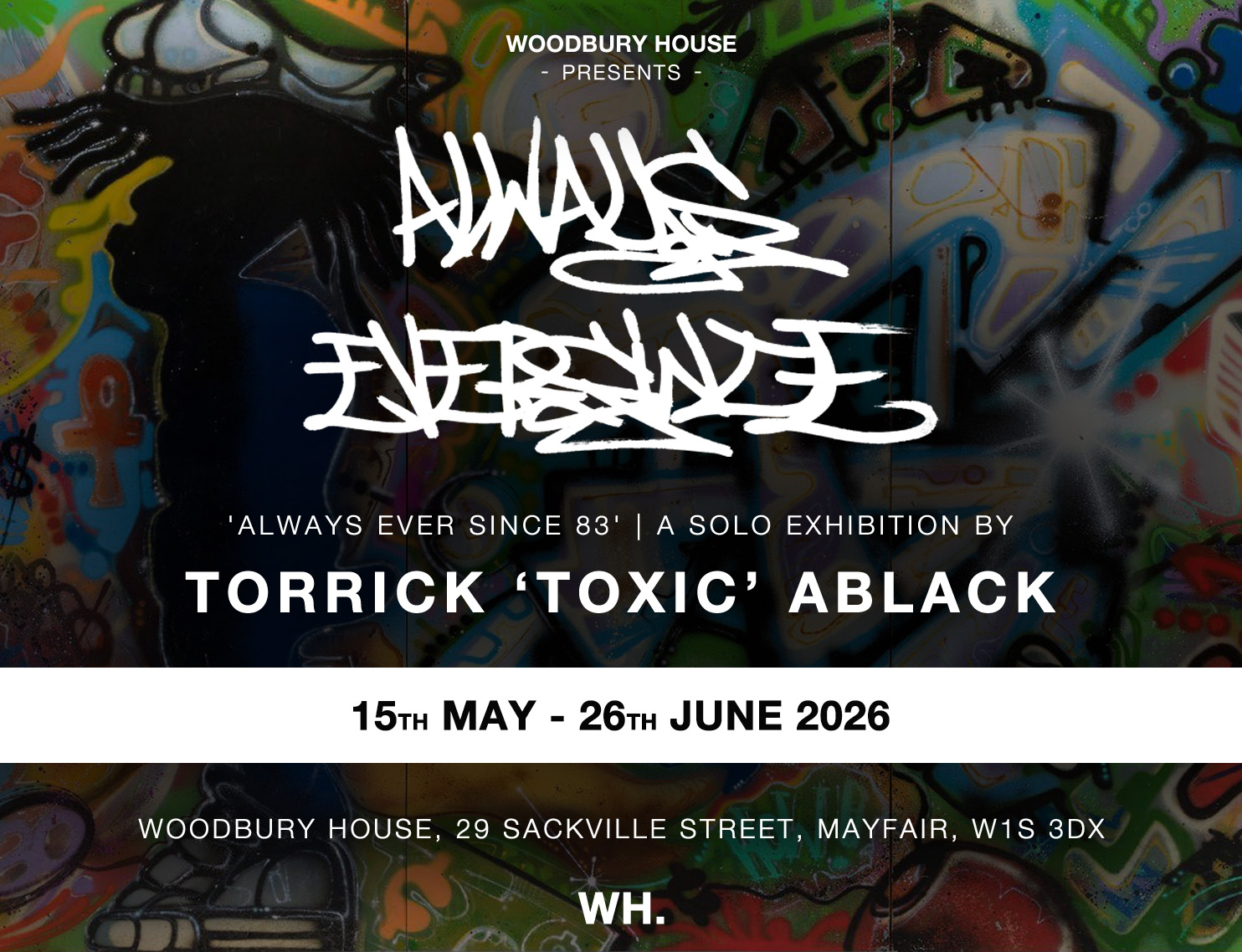
Woodbury House is proud to announce ‘Always Ever Since 83’, a solo exhibition by Torrick ‘TOXIC’ Ablack, on view from 15th May through 26th June 2026.
‘Always Ever Since 83’ is not a retrospective. It is a declaration.
The title is a spin on two words — established since — simple, direct, and entirely in TOXIC’s register. It names the moment — 1983 — not as the year the art world noticed him, but as the year he convinced himself he could be an artist. That internal decision, made quietly, is the true origin point of everything that follows.
Not a debut. Not a discovery by an institution, a gallerist, or a market. A moment of private conviction — the year TOXIC decided, from the inside, that he was an artist. Not because the art world told him so. Because he finally believed it himself.
Everything since has been proof.
The Trigger
People had known him as TOXIC for years before 1983. The name was already in the city — on trains, on walls, moving through New York’s underground with the energy and authority that serious writers carried. The work was already there.
But 1983 was different. And the difference had a voice — one that had spoken the year before.
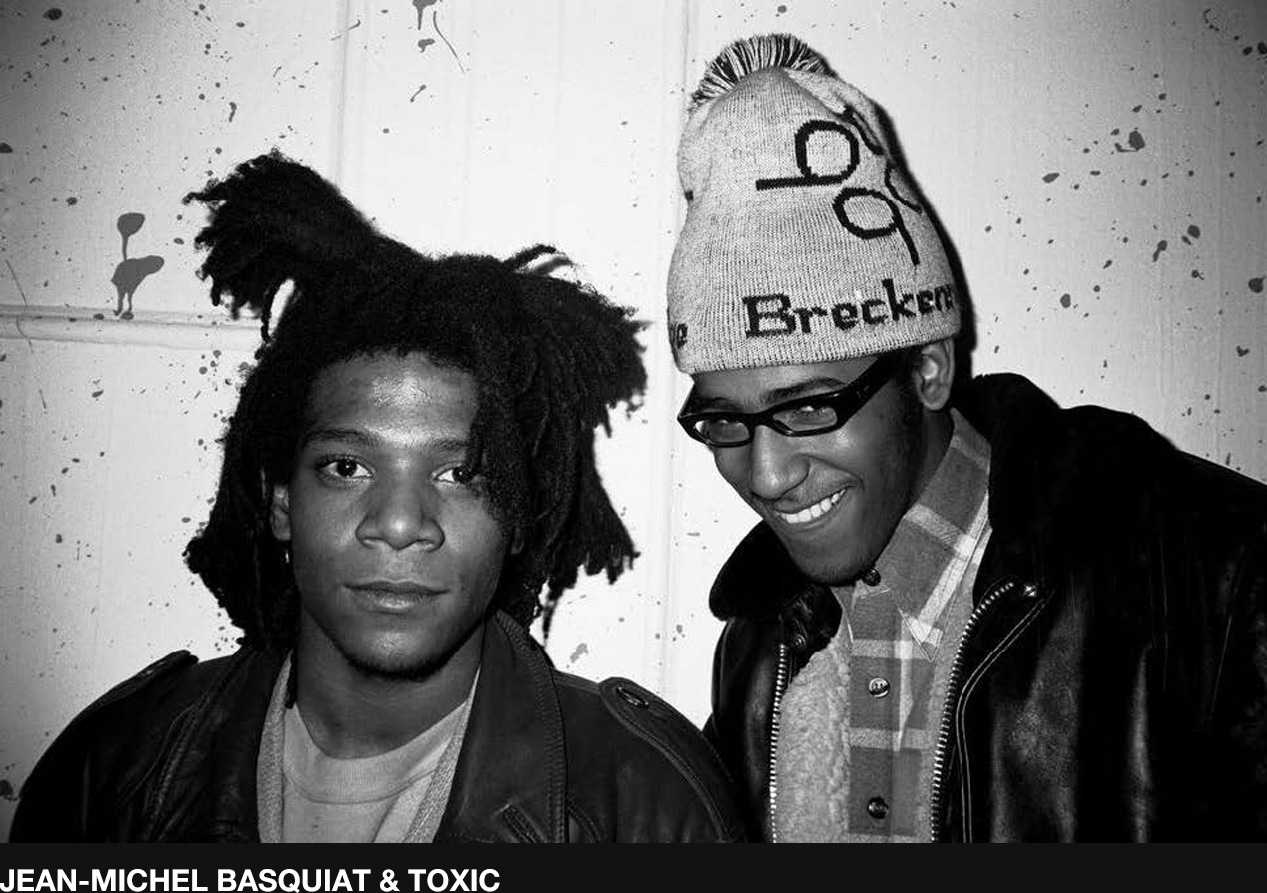
It was Jean-Michel Basquiat who said it. In 1982, looking at what TOXIC was doing — the scale of it, the skill, the language he had developed across the surfaces of New York — Basquiat asked him, simply: “That’s cool. But how are you going to eat with trains?”
It was not a dismissal. It was a recognition. Basquiat was telling him something he perhaps already knew but hadn’t yet let himself believe: that what he was making had a life beyond the subway. That he had the ability. The eye. The discipline. That he could — that he should — become an artist.
That conversation was the seed. 1983 was the year it took root.
Origins
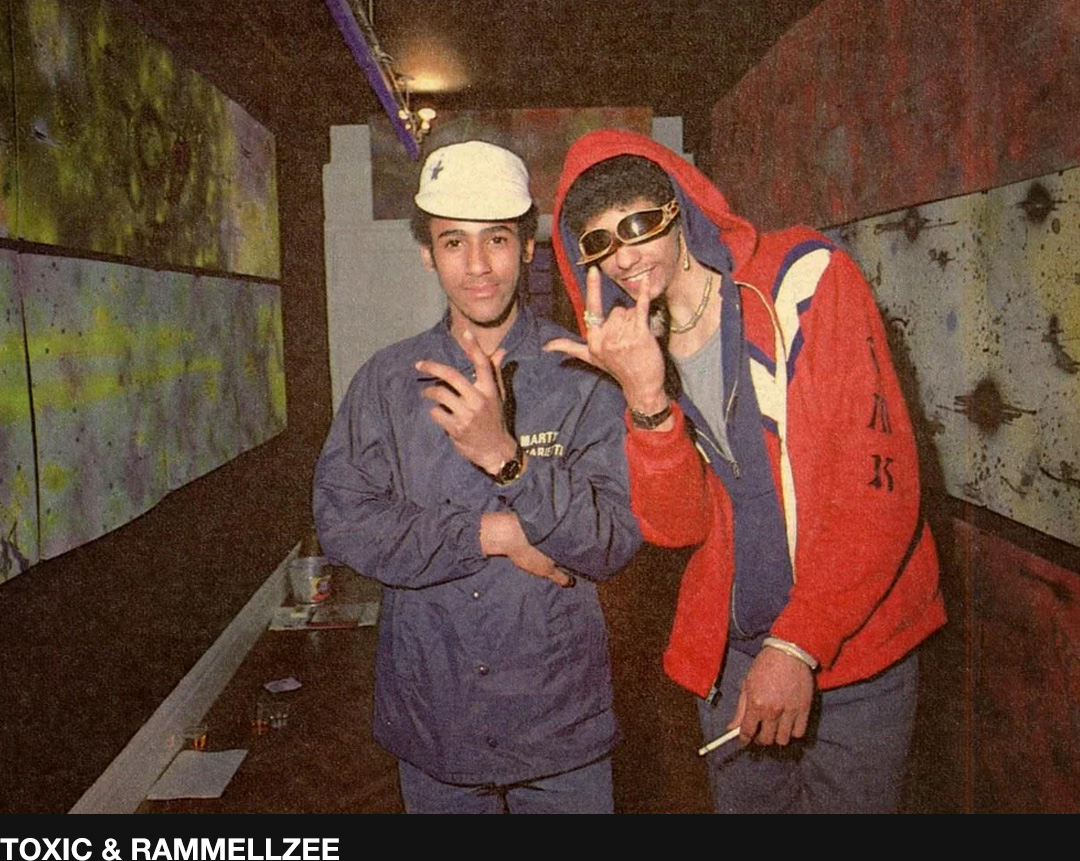
Torrick ‘TOXIC’ Ablack came up during the formative years of New York’s cultural underground — writing on trains, running with Tag Master Killers, moving through a scene defined by urgency, self-determination, and an absolute refusal to be invisible.
Tag Master Killers was not simply a crew in the conventional sense. Under the intellectual architecture of Rammellzee, it was a collective with a philosophy — each member developing their own distinct visual language within a shared theoretical framework. Among them, A-One: an artist who would go on to leave his own significant mark on the era, coining the term aerosol expressionism, and who would later stand alongside TOXIC at the Sidney Janis Gallery. TOXIC’s peers and mentors were the figures who would come to define a generation: Jean-Michel Basquiat, Rammellzee, Lee Quiñones. He was not peripheral to that world. He was inside it.
Rammellzee was his mentor — a theorist as much as an artist, whose framework of Ikonoklast Panzerism treated letterforms as armoured language: symbols of war against cultural control. That intellectual framework runs through TOXIC’s work to this day. It is not historical colour. It is structural.
Hollywood Africans
The full weight of 1983 only becomes clear when its events are held together.
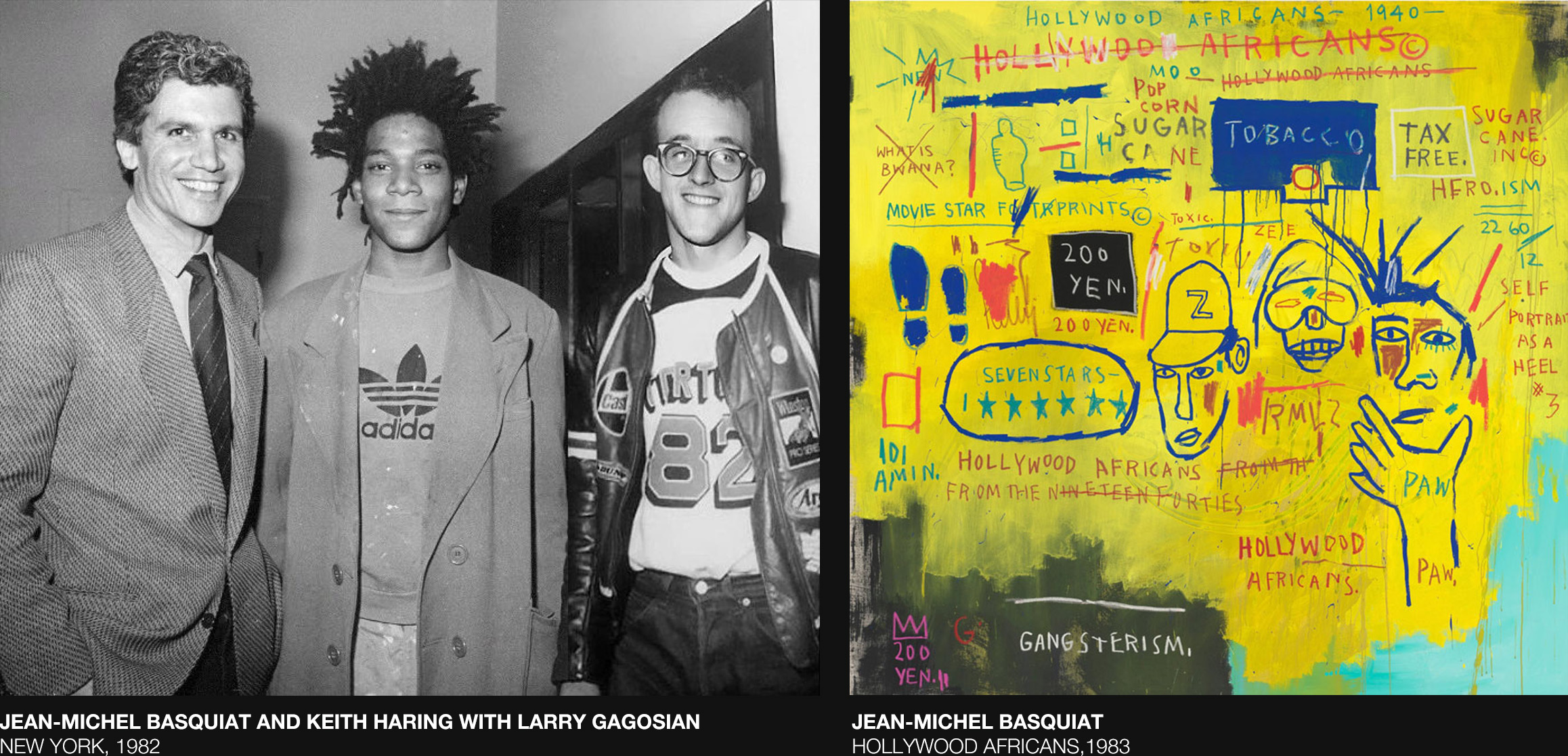
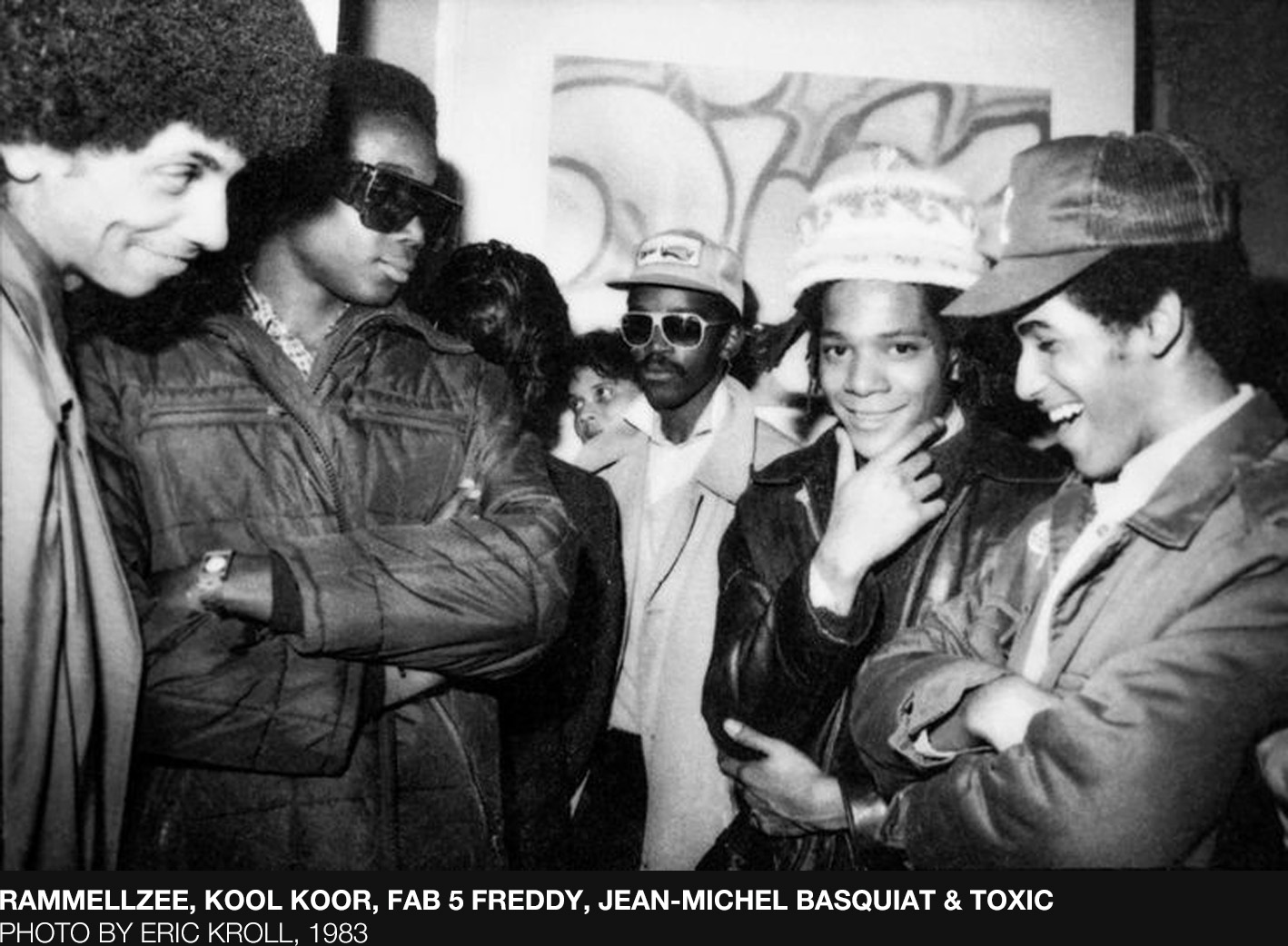
That year, Jean-Michel Basquiat returned to Los Angeles for another exhibition with Larry Gagosian. He brought TOXIC and Rammellzee with him. What they encountered there — inside those galleries, at those openings, in those rooms — became the subject of the painting Basquiat made in response.
Hollywood Africans depicts all three of them. Its title was not a celebration. It was an observation, delivered with the precision Basquiat reserved for his most political work. They were, quite simply, the only Black people present — in the art world, in Los Angeles, in those rooms, at that time. The painting addresses race, visibility, identity, and the economics of cultural exploitation with the clarity that only comes from being inside the situation rather than observing it.
TOXIC is not a peripheral figure within it. He is present, named, and embedded in one of the most historically significant works of the era — not as context for someone else’s story, but as a subject in his own right.
Across Basquiat’s entire body of work, TOXIC is among the most depicted individuals — rivalled, it is said, only by Charlie Parker. That is not a footnote. That is a measure of how central TOXIC was to Basquiat’s world, his thinking, and his art.
The Institutional Record
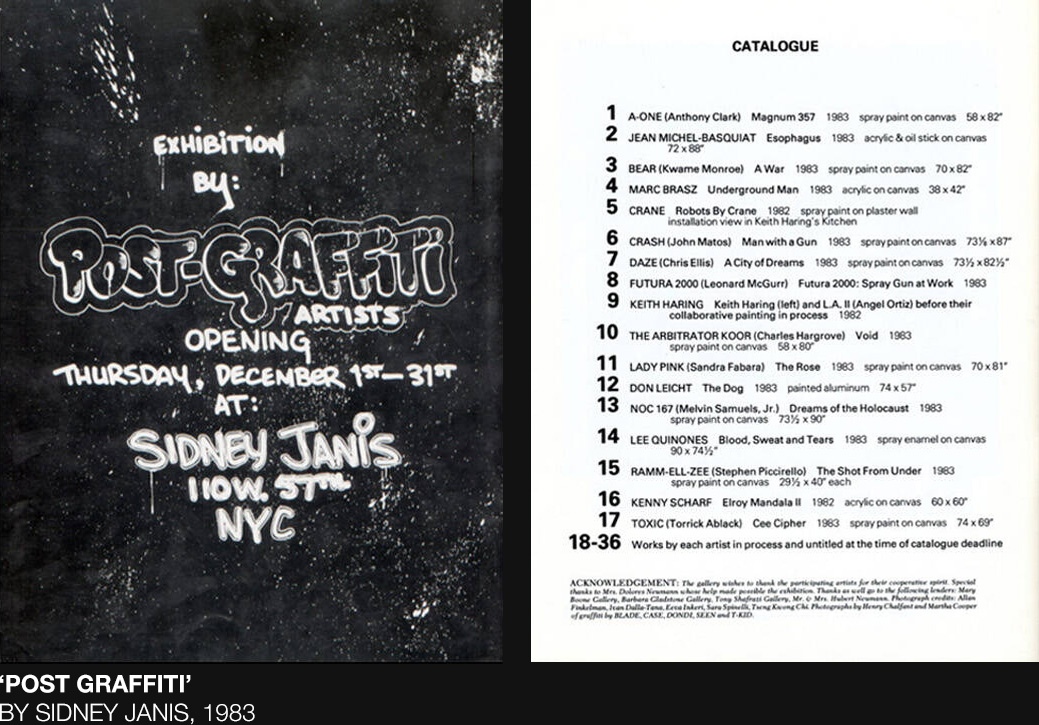
Also in 1983, TOXIC was included in Post-Graffiti at the Sidney Janis Gallery in New York — one of the most consequential group exhibitions of the decade, curated by Dolores Neumann. The roster was a document of the moment: Basquiat, Haring, Futura, Rammellzee, Lee Quiñones — and TOXIC, amongst others.
The Sidney Janis Gallery had been established in 1948, its reputation built on European Modernism, Abstract Expressionism, and Pop. Its embrace of this generation was not a minor cultural footnote. It was a significant institutional endorsement — a signal that what these artists were doing belonged in the same conversation as the movements that had defined the century before them.
Two years later, in 1985, Sidney Janis returned to TOXIC specifically — dedicating an exhibition to just three artists: A-One, Noc, and TOXIC. The gallery did not need to do that. It chose to.
These are not peripheral credentials. They are the primary record.
Transition
The decades that followed were marked by profound loss.
The generation that had built the scene — the writers, the artists, the collaborators, the people who had been in the rooms and on the trains and at the tables where it all happened — began to disappear. Some to AIDS. Some to drugs. Some to violence. Some simply to time and circumstance. Among them, the losses that cut deepest: Basquiat in 1988. A-One — Anthony Clark, fellow Tag Master Killer, co-exhibitor at Sidney Janis, a man of rare talent who had, like TOXIC, made Europe his home — died in Paris in 2001, aged just 37. Rammellzee in 2010. Friends, contemporaries, partners in the work — the people who had known what it actually was, from the inside, before it became history.
TOXIC kept moving. He came to Europe, built a life, and continued to paint — on his own terms, at his own pace, outside the machinery of a market that was busy constructing a narrative about the era he had actually lived. That distance was not exile. It was autonomy. The work continued because the work was never contingent on anyone else’s validation of it.
What the art world was slow to reckon with, history is now correcting.
The Work
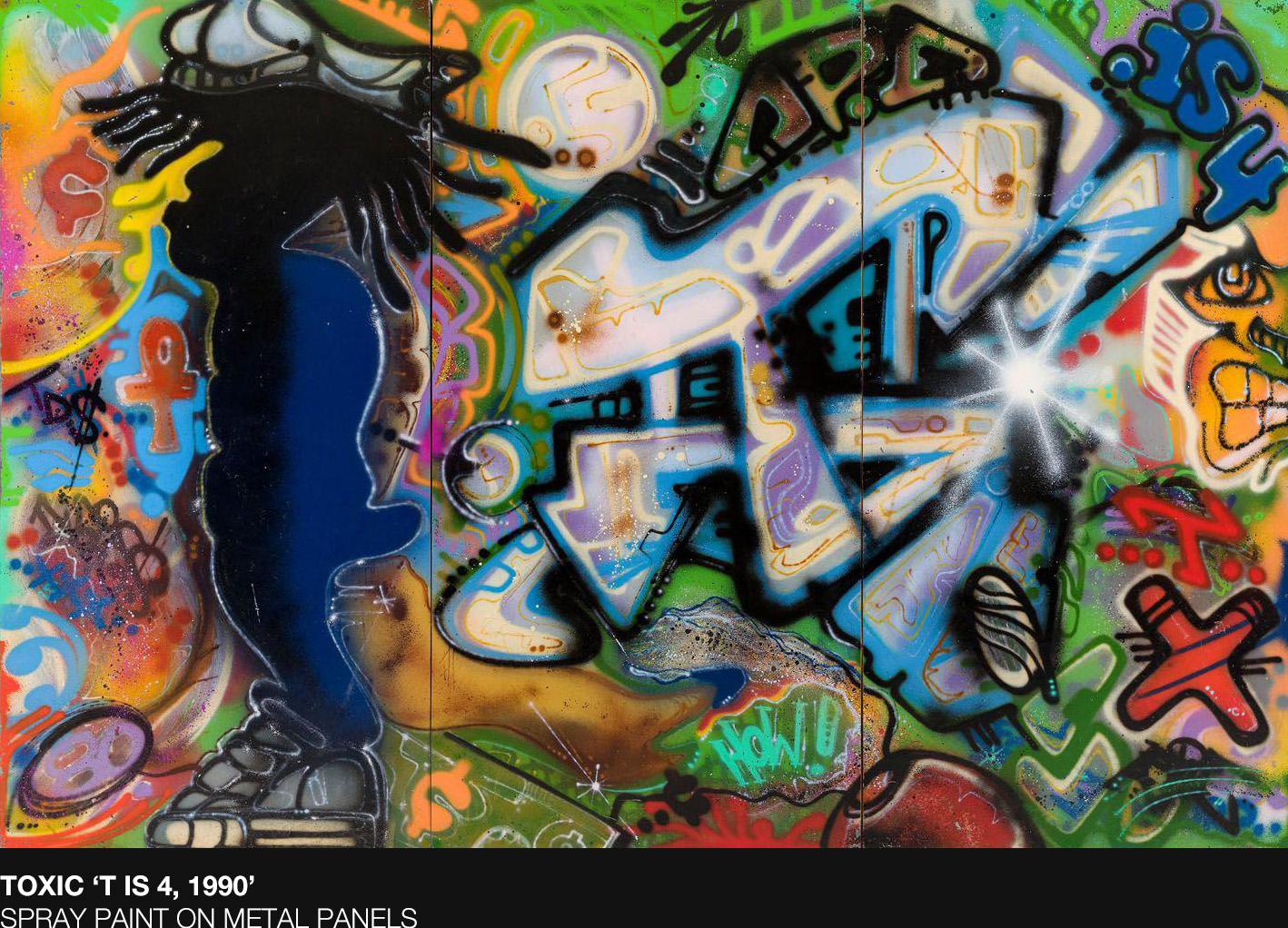
‘Always Ever Since 83’ brings together a new body of work made specifically for this show — paintings that reflect where TOXIC is now, what he is thinking through, what he is refusing to leave unresolved — alongside selected earlier works, with the earliest dating to 1983 itself. Together they make the case not for a career in summary, but for an artist in full stride.
TOXIC describes the process of making the new work plainly: working out his demons. Returning to symbols not out of habit, but because the questions people ask him haven’t changed — which tells him the symbols haven’t yet done their job. So he keeps using them. Keeps explaining. Not because the work is stuck, but because the audience is still catching up.
What he is clear about is this: what those symbols actually mean, and what people were taught they mean, are two different things. That gap — between received interpretation and lived intention — is at the centre of the work. It always has been.
The paintings are layered — acrylic grounds worked slowly, spray paint moving fast over the top. Control and instinct. The figures that emerge are abstract, symbolic, charged with the same visual logic he has been developing for over four decades, but refusing to be frozen by it.
TOXIC has spent his career being labelled, and he has rejected every label, consistently and without apology. The categories were not his. They were applied by institutions more comfortable classifying a culture than engaging with the individual artists inside it.
‘Always Ever Since 83’ asks for something more rigorous. It asks that TOXIC be seen as what he is: a painter with a forty-year body of work, a direct line to one of the most significant cultural moments of the twentieth century, and a studio practice that is currently, demonstrably, at full force.
He was always here. This exhibition simply makes that impossible to ignore.
Presented at Woodbury House
‘Always Ever Since 83’ marks a defining moment in Woodbury House’s programme — and a long overdue reckoning with one of the most important artistic lives of the last forty years.
To be among the first to receive further details regarding available works and the exhibition catalogue, please register your interest by clicking here.