WHO IS RETNA?
The Evolution of Los Angeles Writing
To understand RETNA’s work, you have to understand language as structure rather than speech.
Where early Los Angeles writing established presence and identity, and later documentation captured lived reality, RETNA represents evolution — the moment where writing is rebuilt, abstracted, and re-projected as a global contemporary language. His work does not record culture, nor does it originate it. Instead, it reconstructs it.
Born Marquis Lewis in 1979 and raised in Los Angeles, RETNA is one of the most recognisable script-based artists to emerge from the city. His practice bridges graffiti, calligraphy, and contemporary abstraction, translating street-based writing into gallery, museum, and architectural contexts while retaining cultural intensity and symbolic depth.
RETNA does not ask to be read. He asks to be experienced.
Los Angeles Roots and Writing Culture
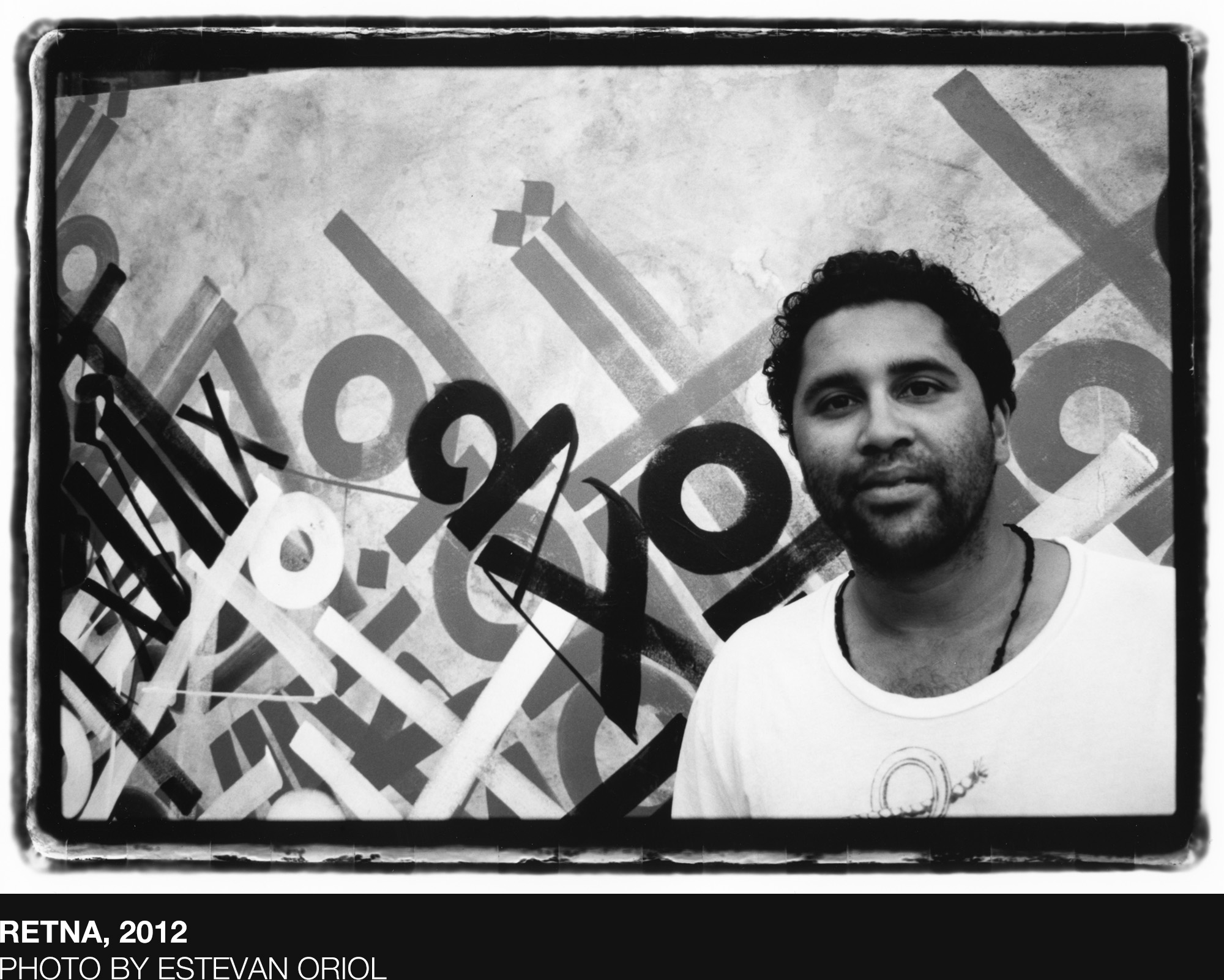
RETNA emerged from the Los Angeles graffiti movement of the early 1990s, a period when writing culture had already developed complex internal hierarchies, stylistic codes, and visual traditions. Unlike many of his contemporaries, his practice was not primarily concerned with legibility, tagging, or name-based authorship as an endpoint.
From an early stage, RETNA approached writing as a system rather than a message. His focus lay in the construction of form — how letters could be built, layered, and reimagined to carry emotional, spiritual, and cultural resonance without relying on literal meaning. This positioned his work apart from narrative graffiti traditions and aligned it more closely with abstraction and calligraphic composition.
Los Angeles provided the conditions for this evolution. As a city shaped by migration, hybrid identity, and global cultural exchange, its visual language has always absorbed and transformed outside influences. RETNA’s practice emerges directly from this environment.
Constructing a Script, Not Preserving One
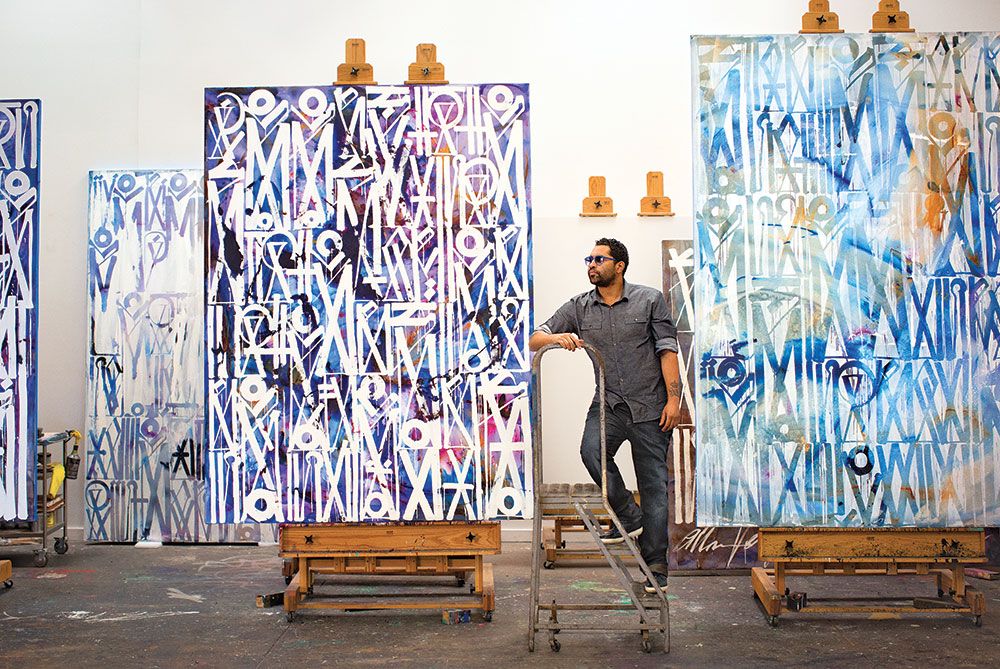
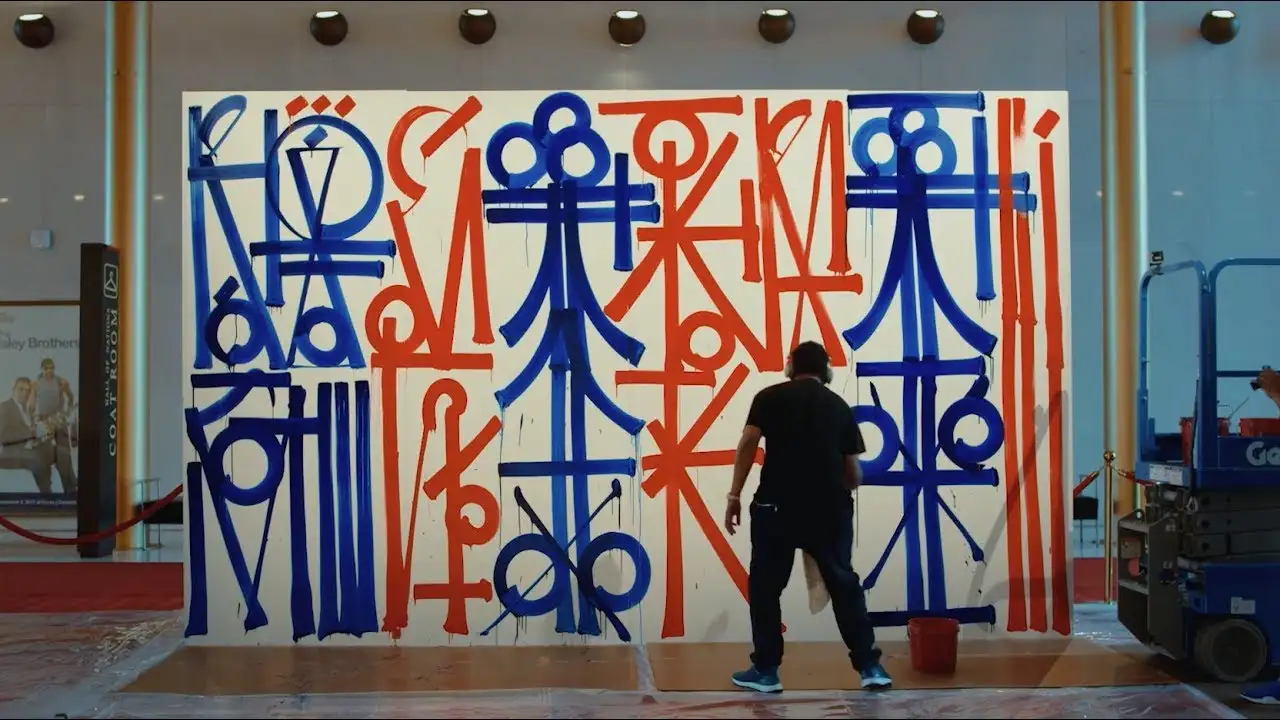
RETNA’s defining contribution lies in the development of his distinctive script-based visual language. Drawing from a wide range of historical and global writing systems — including Blackletter, Egyptian hieroglyphs, Arabic and Hebrew calligraphy, and traditional graffiti handstyles — he constructed an alphabet that feels ancient and familiar, yet resists translation.
This script is intentionally illegible. Language, in RETNA’s work, functions as form rather than communication. Meaning is conveyed through rhythm, structure, density, and gesture rather than words. The result is a visual language that operates symbolically and emotionally, allowing viewers to project their own readings onto the work.
RETNA is not preserving a language.
He is rebuilding one.
This act of construction places his practice firmly within contemporary art discourse, while remaining rooted in the traditions of street-based writing.
From Street to Institution
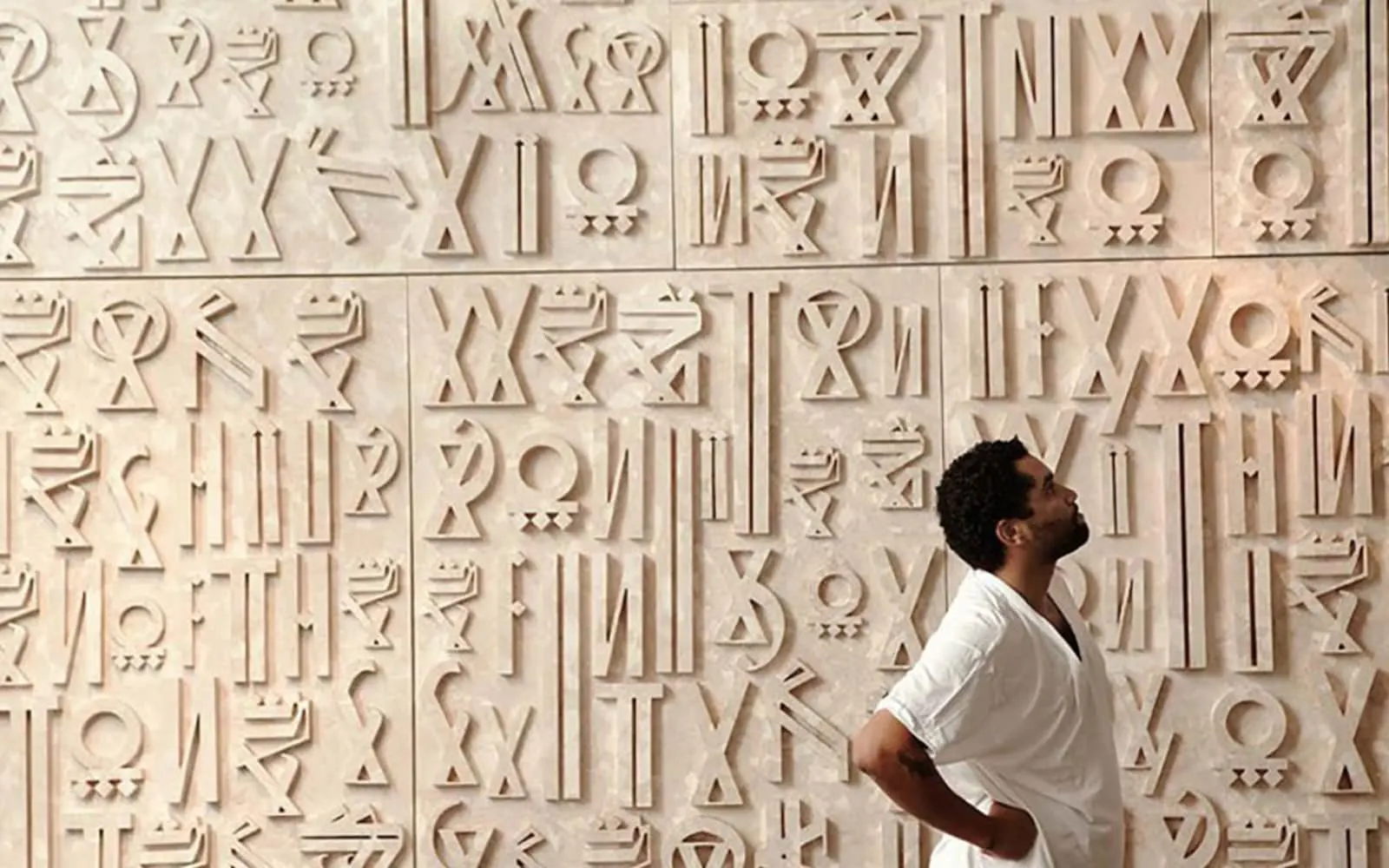
As RETNA’s visual language matured, his work expanded rapidly in scale, ambition, and visibility. He became known for large-scale murals, immersive installations, and paintings that moved fluidly between street, studio, and institutional contexts.
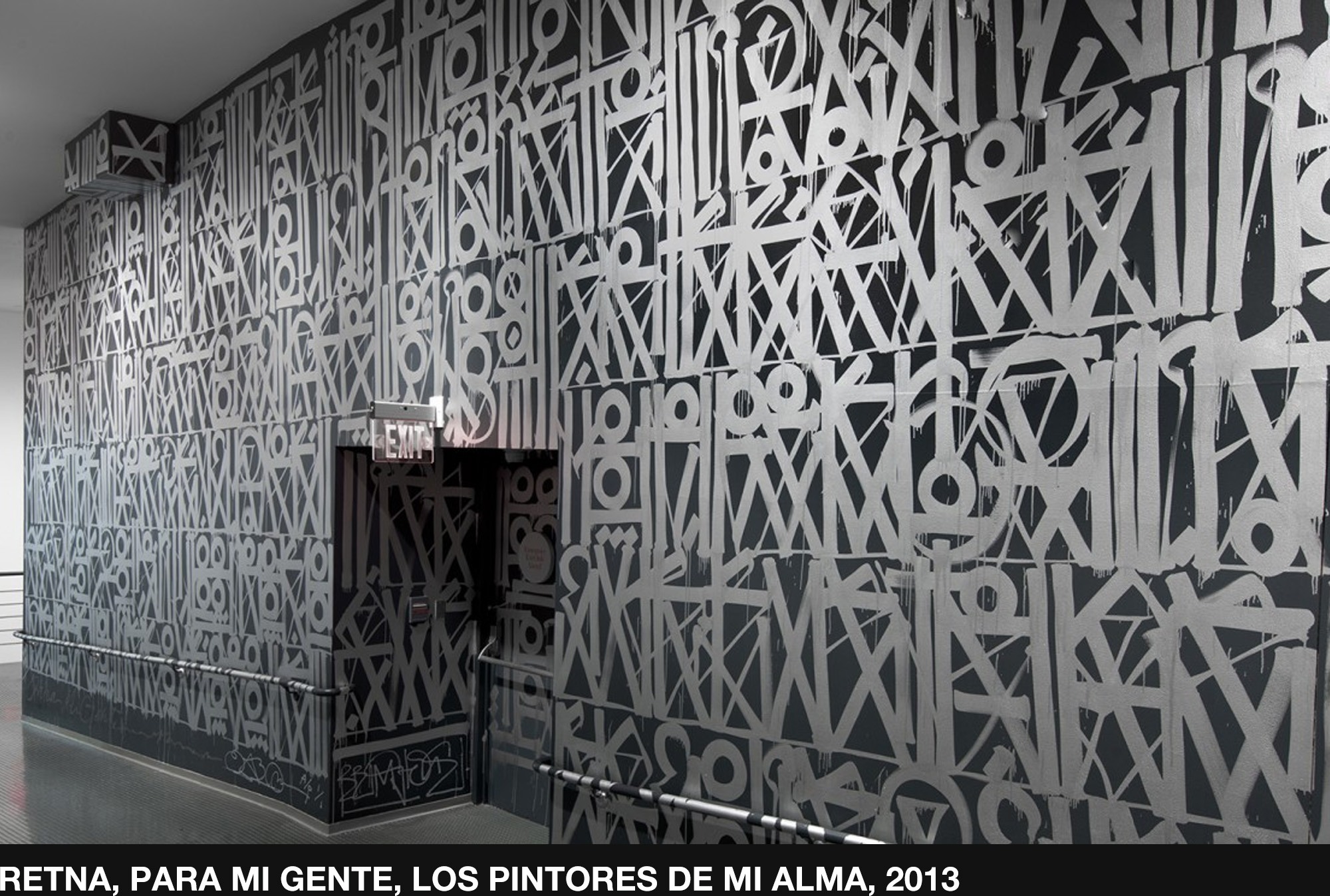
A pivotal moment in this transition came with his inclusion in Art in the Streets at the Museum of Contemporary Art, Los Angeles in 2011 — a landmark exhibition that formally recognised graffiti and street-based practices within the museum context. This was followed in 2013 by RETNA: Para mi gente, a dedicated installation at MOCA that further established his position within contemporary art.
His work is now held in major public collections, including the Los Angeles County Museum of Art and the Museum of Contemporary Art, Los Angeles, confirming institutional recognition that extends beyond street culture.
Scale, Architecture, and the City
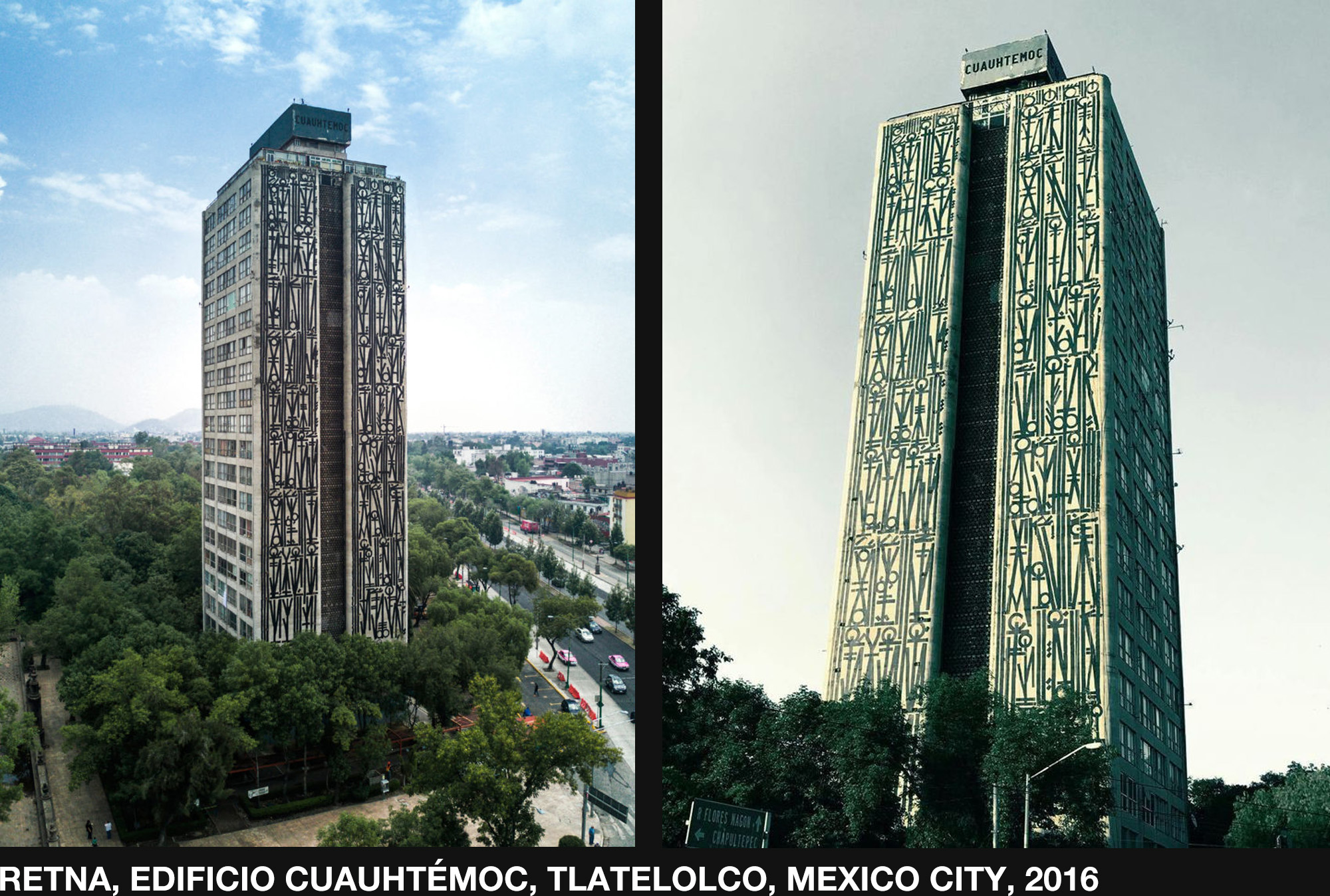
RETNA’s practice is notable for its relationship to scale and architecture. His script has been applied across vast urban surfaces, embedding his visual language directly into the built environment. Among the most significant examples is his 24-storey mural on the Edificio Cuauhtémoc in Mexico City, where writing becomes architecture and language becomes structure.
These monumental works reinforce the idea that RETNA’s script is not decorative. It is spatial, rhythmic, and architectural in nature, designed to be encountered physically as much as visually.
This capacity to operate across scale — from intimate works on canvas to monumental public interventions — is central to his practice.
Technique and Control
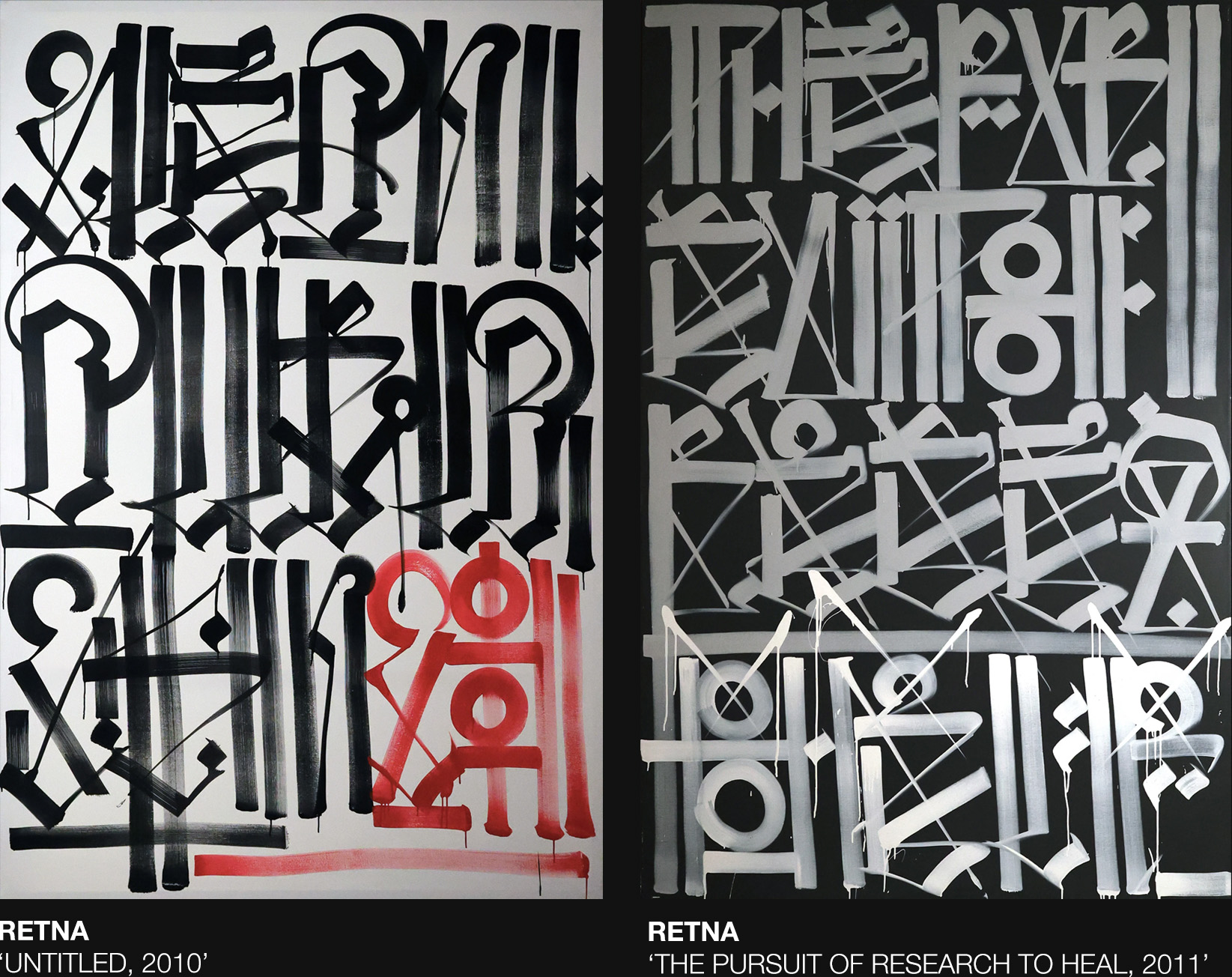
RETNA’s process mirrors the conceptual core of his work. Emerging from a foundation in spray paint and street-based writing, his practice incorporates hand-applied brushwork, acrylic, and ink, allowing him to move between expressive gesture and precise line. This technical hybridity reflects the balance within his compositions: control and spontaneity, structure and movement.
The works carry a sense of internal order. Each mark relates to the next, creating compositions that feel both disciplined and alive. This balance is key to understanding RETNA’s position within contemporary abstraction.
Influence Beyond the Gallery
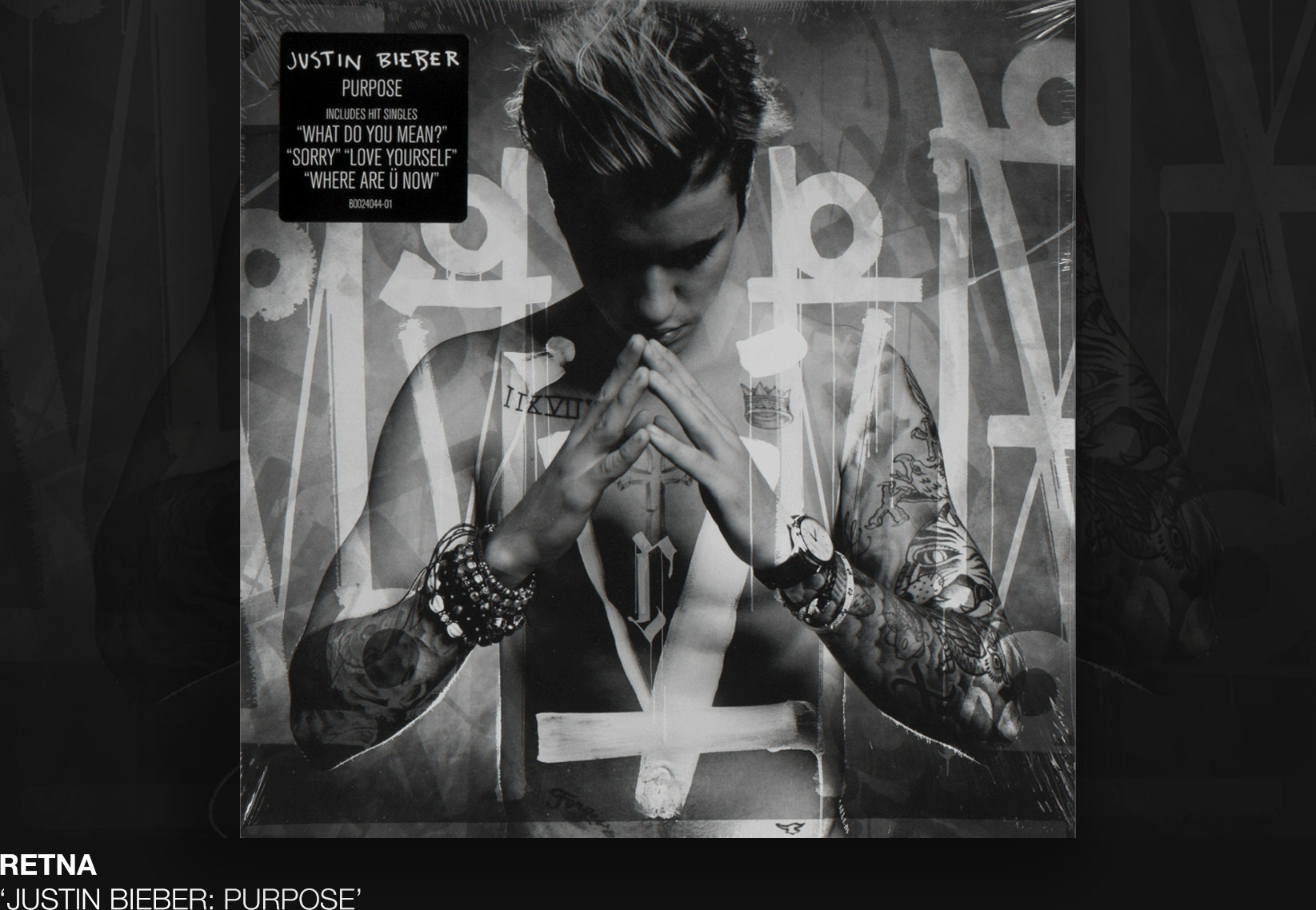
RETNA’s visual language has extended far beyond the gallery and museum. His script has intersected with music, fashion, and global visual culture, appearing on the cover of Justin Bieber’s Purpose album and through collaborations with international brands including Louis Vuitton, Chanel, and Nike.
He has also designed stage environments for operatic productions such as Aida at the Washington National Opera and the San Francisco Opera, demonstrating the adaptability of his language across disciplines and contexts.
These projects reflect the universality of RETNA’s script. Though illegible, it resonates across cultures precisely because it is not bound to a single linguistic system.
Collecting RETNA
To collect RETNA is to engage with the evolution of Los Angeles writing into contemporary abstraction. His work represents a fully constructed visual language — one that operates simultaneously as calligraphy, abstraction, and cultural synthesis.
RETNA’s paintings are not meant to be read. They are meant to be experienced. Each work offers a balance between gesture and control, intimacy and scale, tradition and reinvention. For collectors, this places RETNA within a clear lineage: neither origin nor documentation, but expansion.
His relevance is not dependent on trend cycles. It is grounded in the coherence and durability of the language he has built.
RETNA at Woodbury House
RETNA continues to live and work in Los Angeles, maintaining a practice rooted in writing, language, and the evolving visual codes of the city.
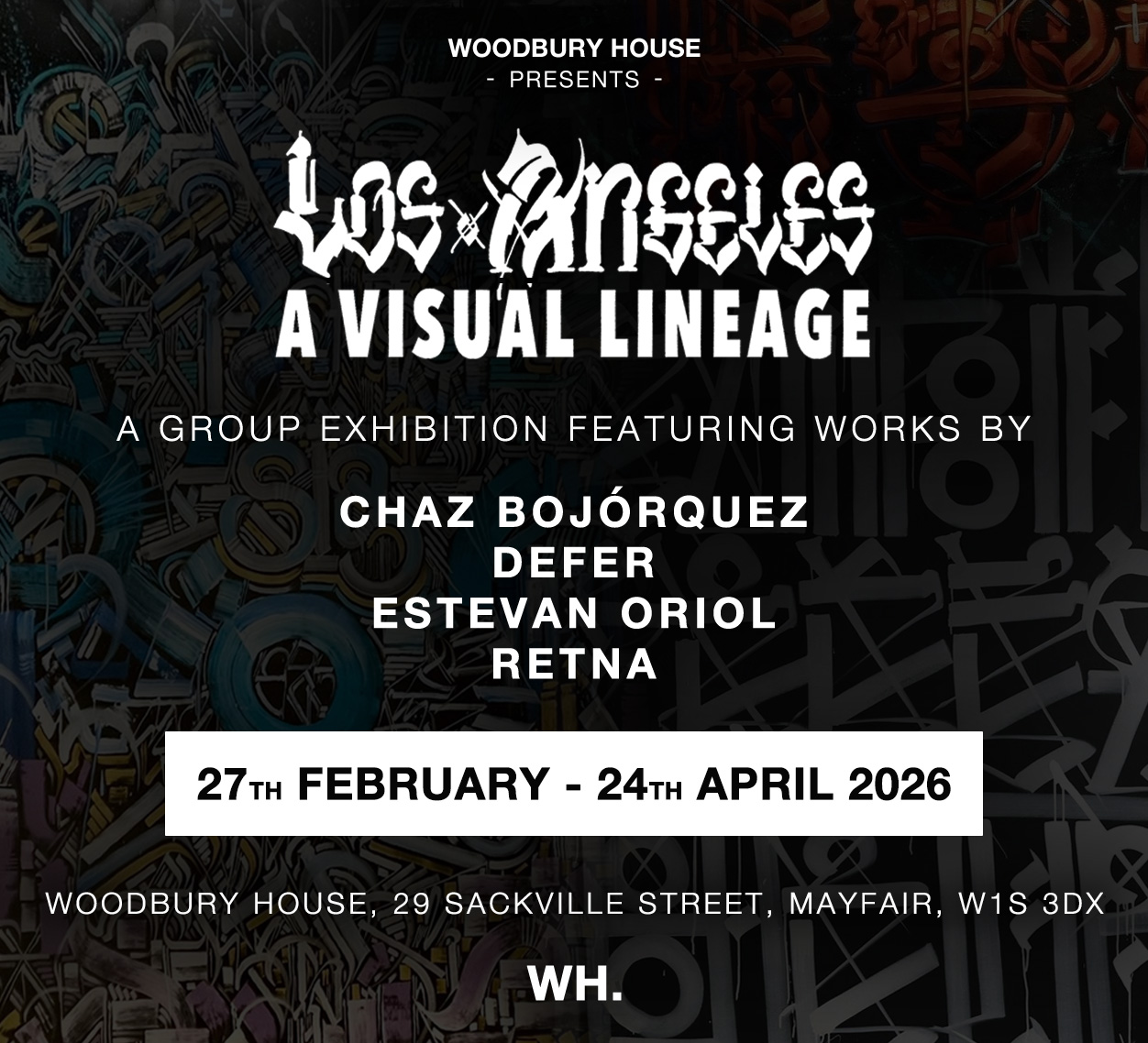
At Woodbury House, we present RETNA as a pivotal figure within the Los Angeles lineage — an artist who transformed inherited street language into a global contemporary visual system. His work was presented as part of our group exhibition ‘LOS ANGELES: A VISUAL LINEAGE’, alongside Chaz Bojórquez, DEFER, and Estevan Oriol.
RETNA’s practice is not concerned with legibility or narrative.
It is concerned with structure, rhythm, and form.
When this is understood, the work reveals its depth.
Register your interest for ‘LOS ANGELES: A VISUAL LINEAGE’ via the link below:
https://woodburyhouseart.com/los-angeles-a-visual-lineage-register-interest/